
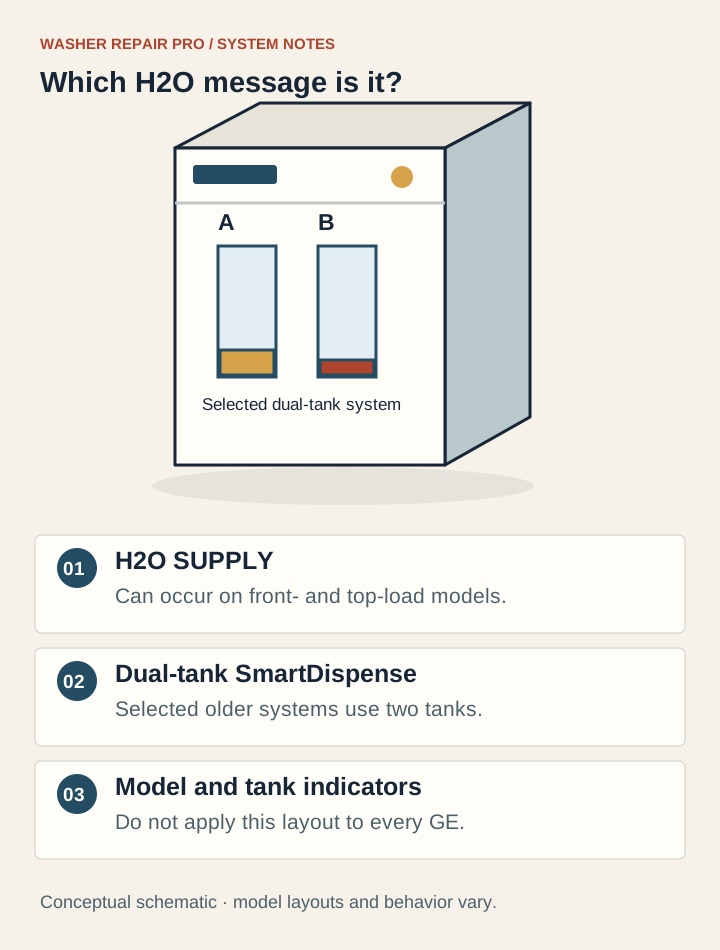
On the GE top-load SmartDispense system described in GE’s H2O article, low bulk detergent and fabric-softener tanks can prevent a cycle from starting. Confirm that your washer has that matching dual-tank system. H2O SUPPLY on other GE washers and SmartDispense on newer single-tank models require their own instructions.
What the message is responding to
In GE’s documented dual-tank condition, the selected bulk dispensers are recognized as empty when both tanks are low, and the washer can chime without beginning the wash. GE’s isolation check turns off both bulk dispensers and attempts a cycle. A successful start points toward the dispenser condition; it does not identify a failed dispenser component.
Two Bulk Tanks Are the First Requirement
Find the complete model number and inspect the tank labels and panel controls. This route needs separate bulk detergent and liquid fabric-softener storage matching the owner manual. A small single-dose softener cup is not proof of a bulk softener tank. Having SmartDispense printed on the washer also does not establish the correct system.
GE describes bulk detergent-and-softener tanks on its 2016-and-older top-load SmartDispense page. Its separate 2017-and-newer top-load article describes a detergent reservoir without a fabric-softener tank. These support pages establish different designs, not a complete compatibility list. Use the exact manual to decide which guidance belongs to the machine in front of you.
| What You Find | Decision |
|---|---|
| Matching dual bulk tanks, H2O, and low-tank indications | Use the documented dual-tank dispenser check. |
| One bulk detergent tank plus a small softener cup | Do not apply the dual-tank test from this article. |
| H2O SUPPLY on a top-loader | Use matching supply/no-fill guidance; top-load alone is insufficient. |
| Unknown model or tank layout | Identify the model before adding products or changing dispensing settings. |
Compare Enabled and Disabled Bulk Dispensing
For a confirmed matching model, follow the owner manual to turn off both bulk detergent and bulk fabric-softener dispensing, then make the single cycle-start attempt GE describes. Note whether filling and washing begin. If the cycle starts, GE identifies the bulk dispenser condition as the relevant route; if it does not, this check has not established that refilling will solve the problem.
Record which tank indicators were lit before the attempt and whether both dispenser selections actually turned off. Do not substitute a random button combination or a reset from another model. A useful service note states the settings, tank indications, and result rather than simply saying that the dispenser was tested.
Why a Small Refill May Still Read Empty
A tank that has run completely dry can have an initial-fill requirement different from an ordinary top-up. GE’s H2O support article and its older dual-tank overview describe priming and level indications, but their numerical refill guidance differs. Use the matching manual’s filling instructions and limits instead of treating a bottle size quoted online as universal.
Use only the products and compartments approved by that manual. Do not add water, extra detergent to the tub, or repeated small bottles as an improvised H2O fix. Before the next regular wash, confirm whether bulk dispensing remains enabled so you do not unintentionally combine automatic and manual doses.
If Refilling or Resetting Has Already Failed
List what you added, which tank received it, whether it was an initial fill after emptying, and how the indicators responded. Include any reset already attempted. A visible amount of product and a low indication are observations to report; they do not prove a failed sensor or pump. Reports from other SmartDispense generations cannot identify the cause on this one.
GE recommends service if the matching tank refill does not correct this dispenser condition. Stop owner troubleshooting when the model does not match, the tank contents are uncertain, or the documented check fails. Leave internal dosing components, wiring, and sensor diagnosis to service. For leakage, burning smells, smoke, or repeated breaker trips, stop using the washer.
Questions owners ask
Does every GE top-load H2O message mean empty SmartDispense tanks?
No. Some top-load models display H2O SUPPLY for a supply or no-fill condition. Match the full display and tank configuration before using the dual-tank dispenser route.
Can I use this check on a newer single-tank SmartDispense washer?
Do not assume it applies. GE separately documents newer top-load designs without a fabric-softener tank. Use the manual for that model rather than a test requiring two bulk dispensers.
What does it mean if the washer starts with both bulk dispensers off?
On the matching system, GE says that result points to the bulk dispenser condition. Follow the model’s tank-filling instructions; it does not by itself establish which internal component needs repair.
How much detergent should I add to clear H2O?
Use the exact dual-tank model’s initial-fill and maximum-level instructions. GE’s general pages give different numerical refill guidance, so neither a small-bottle size nor a priming amount should be applied to all SmartDispense machines.
Why can a filled tank still show low or empty?
Confirm the model, initial-fill instructions, correct compartment, and indication history. An accessible owner thread reports this on a different SmartDispense design, but it does not diagnose your washer. Persistent indications after the matching procedure need support.
Keep the useful details for service
Record the full model, exact display, cycle stage, water location and checks already attempted. Create a repair brief to copy or download. If several symptoms overlap, use the Washer Repair Check without guessing a component.
Related next steps
Sources & model scope
Content reviewed November 5, 2026. Match the exact model and US owner’s manual. These references support the explanation; they are not evidence of an inspection of your machine.
Questions behind this guide
Owner discussions helped identify confusing follow-ups and prior attempts. They are individual experiences; manufacturer information supports the technical explanations above.