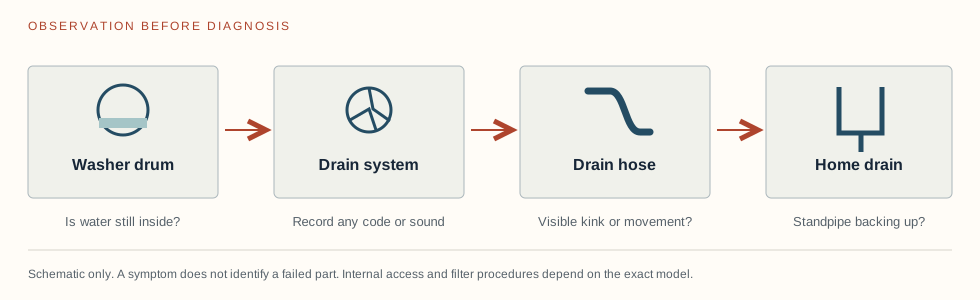
Start with the water location
Water trapped inside a washer suggests an appliance drainage or cycle issue. Water rising out of a standpipe suggests the home drain needs attention too. Water at a wall valve or hose connection can require a supply-side inspection. These are routes to investigate, not final diagnoses.
Check whether the problem is shared
If several fixtures are affected, note that before requesting washer service. Building-wide low water pressure or multiple backed-up drains should be discussed with the building manager, utility or plumber. A washer-only symptom with normal surrounding fixtures may follow an appliance route.
Describe timing without running a new test
Say whether the event occurred while filling, washing, rinsing, draining or while the washer was idle. If you already have a short video or photograph, keep it. Do not run another leaking or electrically unsafe cycle merely to collect evidence.
When the trades overlap
A technician may need the household drain or supply corrected before completing an appliance test. Conversely, a normal home drain does not prove the washer’s internal path is clear. Ask who is responsible for diagnosis, what access is needed and whether a second visit can incur another charge.
What to say on the first call
“Water comes out of the standpipe only when the washer drains” is more useful than “the washer is broken.” “Water stays inside the drum and the display shows OE” is a different request. Avoid naming a replacement part unless a technician has already confirmed it.