
On the Whirlpool front-load families covered here, F9 E1 means water is not draining as expected. Start with what remains in the drum and the visible drain arrangement. The code identifies a drainage condition; it does not establish that the drain pump needs replacement.
What the message is responding to
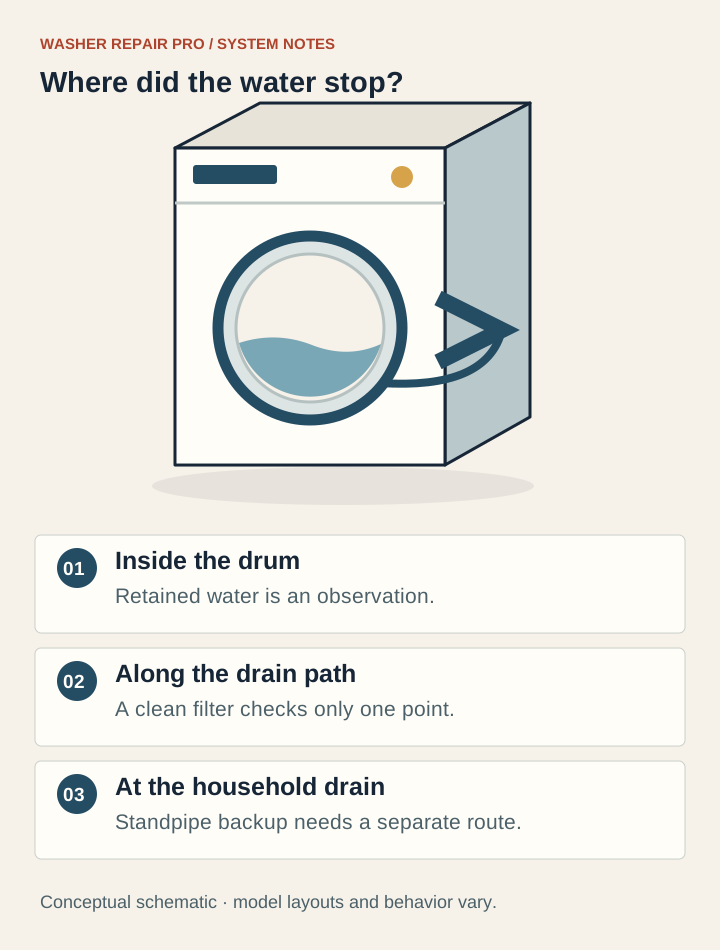
Water has to leave the tub through the washer drainage path and reach the household drain. A restriction, an unsuitable hose arrangement, or excessive suds can interfere with that process. F9 E1 records the unsuccessful result. Pump sound alone cannot establish that water is moving adequately.
Match the Front-Load Manual First
Find the complete model number, including its final characters, and open its US owner and installation instructions. Whirlpool also uses F9 E1 on some top-load platforms; their dimensions and access arrangements cannot be carried into this front-load guide. A search result showing the same characters is only the beginning of a model match.
Before changing anything, photograph the display and note whether the failure occurred after wash, during a rinse, or approaching spin. Record standing water, a slow fall in water level, visible foam, and any earlier cleaning or reset. These observations give a technician more useful information than a guessed part name.
Separate the Washer From the Household Drain
Look from a safe position without pulling out or tilting the machine. Note an obvious hose pinch, a hose pushed unusually deep into the standpipe, or a taped, sealed drain opening. Compare the arrangement with the installation instructions before making a correction. Whirlpool describes an air gap at the standpipe and warns about excessive insertion; the exact manual controls the installation.
If a utility sink or standpipe backs up when discharge reaches it, include that in the report. A household drain problem needs attention even if the washer pump can still move some water. Do not repeat full cycles to see whether an overflowing drain clears itself.
| What You Observe | Next Decision |
|---|---|
| Water remains; no household backup seen | Document the level and check the visible hose arrangement. |
| Sink or standpipe backs up | Stop retrying and arrange household-drain assessment. |
| Very foamy load before the fault | Record detergent type and dose; consult the HE detergent instructions. |
| Drum looks empty but F9 E1 returns | Request diagnosis; visible emptiness does not identify the failed component. |
Use Only Documented Owner Access
A filter-cleaning video is useful only when its access matches your washer. Whirlpool describes a pump filter behind a lower drawer on some models, not every model. If your owner manual provides a cleaning procedure, follow its power-isolation and controlled-water-draining steps before opening the filter. Hot water, a high retained water level, or inability to contain discharge ends the owner check.
Do not remove a cabinet panel to create access that the owner manual does not offer. If an approved cleaning was already completed, report what was found and whether the next attempt drained differently. A clean filter narrows that one observation; it does not confirm the rest of the drainage system is clear.
When a Previous Fix Has Not Lasted
If the same long-drain behavior returns after an appropriate external correction or documented cleaning, stop repeating resets. Ask for diagnosis of the complete drain path and the washer’s response to draining. Include the full model, photos, water-level behavior, detergent details, and work already done. A new pump should follow diagnosis rather than serve as a test purchase.
Stop using the washer for leakage, an electrical smell, smoke, or repeated breaker trips. Keep clear of wet outlets. Internal pump removal, wiring checks, pressure-system work, and electrical measurements belong to qualified service.
Questions owners ask
Why does F9 E1 come back after I cleaned the filter?
Cleaning addresses only that accessible collection point. Keep the result in your service notes and check the documented hose installation. If the fault returns, request diagnosis rather than opening more panels or assuming a new pump is required.
Can the pump make noise while the washer still fails to drain?
Yes. Sound is an observation, not proof of adequate discharge. Note whether the water level falls and whether the household drain backs up. Avoid running repeated loads simply because the pump can be heard.
Does every Whirlpool F9 E1 washer have a front filter door?
No universal access location is established by this code. Whirlpool labels filter guidance for some models. Use the matching owner manual; stop if access requires removing a cabinet panel.
Can too much detergent contribute to F9 E1?
Whirlpool identifies excessive suds as a possible source of drain delays. Record the detergent’s HE marking, concentration, and measured dose. That possibility does not prove detergent caused a recurring fault.
Is F9 E1 the same repair procedure as F21?
Both can describe drainage trouble, but they occur across different Whirlpool families. Match each code to the full model and its manual before using a reset, hose dimension, or filter procedure from another guide.
Keep the useful details for service
Record the full model, exact display, cycle stage, water location and checks already attempted. Create a repair brief to copy or download. If several symptoms overlap, use the Washer Repair Check without guessing a component.
Related next steps
Sources & model scope
Content reviewed November 5, 2026. Match the exact model and US owner’s manual. These references support the explanation; they are not evidence of an inspection of your machine.