
F21 on the Whirlpool front-load models described here indicates a drain problem. Inspect the visible drain-hose arrangement and note whether water remains or a household drain backs up. A reset may clear a display; it cannot establish that an obstruction or other drain fault has been repaired.
What the message is responding to
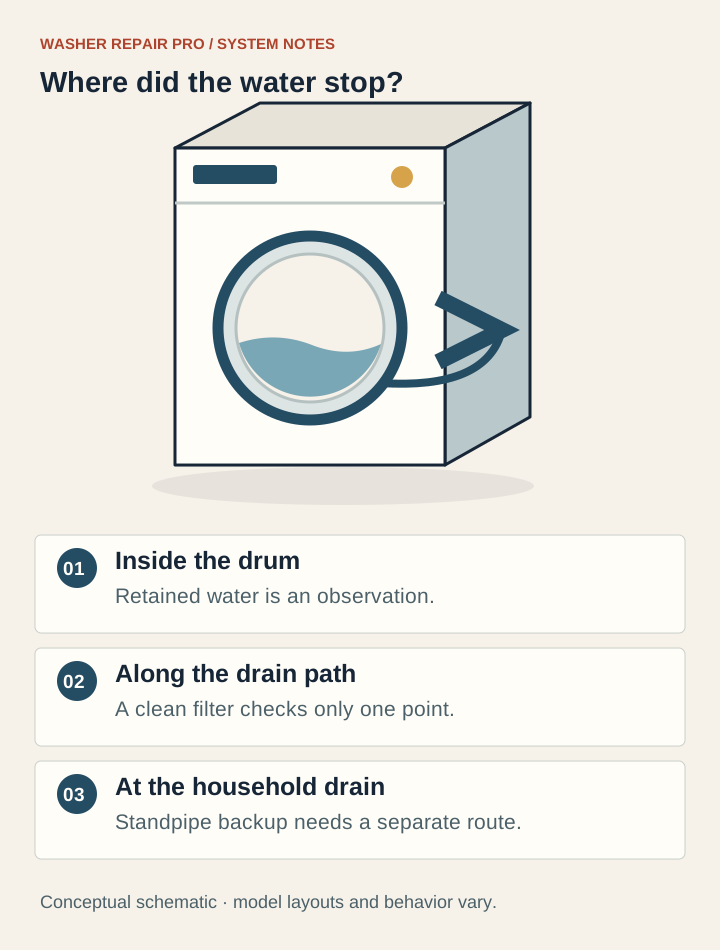
During pump-out, water must pass through the washer drainage system and into the household plumbing. Restricted flow or excess suds can delay this process. F21 identifies the drainage problem detected by the washer, without identifying which hose, pump, or other component caused it.
F21 Needs Its Own Model Match
Read the complete model from the appliance label and use the matching US owner manual. F21 appears on Whirlpool front-load families, including older Duet machines, but a guide for F9 E1 does not establish your filter location, control sequence, or installation dimensions. Photos of another washer can make an inaccessible part look like routine owner maintenance.
Write down the cycle and stopping point, whether the drum holds water, and whether the clothes are saturated. Also record any earlier Sud or Sd display and the detergent used. Distinguish an uninterrupted long pump-out from a code that reappears immediately after restoring power. Do not enter service diagnostics merely to generate additional codes.
Use the Visible Evidence to Choose the Next Step
From a safe position, look for an externally visible hose pinch and note whether the sink or standpipe backs up. Do not remove the hose or move a stacked washer to investigate a hidden section. The installation instructions show how the hose should be supported; an installer can check an arrangement you cannot reach safely.
Visible foam and a preceding suds message make the detergent history useful. Whirlpool explains that too much detergent or a non-HE product can contribute to drainage concerns. That history is a clue, not a reason to assume every F21 is caused by soap. Adding cleaner, vinegar, or more detergent does not establish a clear drain path.
| Evidence | What to Do With It |
|---|---|
| Fault began after the washer was moved | Ask the installer to verify the hose arrangement. |
| Sink or standpipe overflows | Stop retries and arrange a household drain check. |
| Filter cleaning changed nothing | Report what was cleaned; request assessment of the remaining path. |
| F21 returns after a reset | Treat it as an unresolved condition, not a prompt for another reset. |
A Documented Reset Is a Limited Check
Whirlpool’s F21 support guidance describes disconnecting power for five minutes; its longer F21/F02 article first describes Pause/Cancel where that control is present. Use the matching manual and only an outlet you can reach safely while dry. Record any reset already tried so a support agent knows what happened afterward.
If one appropriate attempt clears the display, observe the next normal use for actual drainage and recurrence. Clearing a message alone is not evidence of recovery. Stop if discharge backs up, water leaks, or F21 returns. Do not repeatedly run loaded cycles to keep the washer working between faults.
When Cleaning or a New Pump Has Not Solved It
Filter access is a model decision. Follow a cleaning procedure only when your owner manual explicitly provides it, including safe power isolation and controlled draining. Retained hot water, inability to contain the water, or cabinet-panel removal puts this beyond the owner check. Do not force the door to retrieve wet clothes.
If a filter was already cleaned or a pump replaced, give service that history along with the full model and discharge behavior. Those attempts do not verify every hose or the washer’s ability to recognize an empty tub. Leave internal inspection and electrical measurements to a qualified technician. Stop immediately for leakage, burning smells, smoke, or repeated breaker trips.
Questions owners ask
Why is F21 still showing after I cleaned the drain strainer?
A clean strainer does not establish that the entire drain path is clear or that the washer is draining correctly. Record the cleaning and whether any water level changed. A recurring code needs diagnosis rather than repeated disassembly.
Can F21 remain after a drain pump was replaced?
An owner forum question reports that situation, but it does not establish a common cause. Tell service exactly which part was fitted and what changed. The code alone never confirms the next replacement part.
How long should I unplug a Whirlpool washer for F21?
Whirlpool’s cited F21 support page specifies five minutes. Confirm that procedure against your model instructions and use only a safely accessible dry outlet. If you already tried it and F21 returned, arrange assessment rather than repeat it.
Can non-HE detergent contribute to F21?
Yes. Whirlpool lists non-HE detergent and excessive suds among possible drainage contributors in its F21/F02 guidance. Check the product label and measured dose, while treating continuing drainage trouble as unresolved.
Are F21 and F9 E1 interchangeable instructions?
No. Similar drainage meanings do not establish identical controls, installation limits, or filter access. Use the complete model number and its manual before applying either guide’s procedure.
Keep the useful details for service
Record the full model, exact display, cycle stage, water location and checks already attempted. Create a repair brief to copy or download. If several symptoms overlap, use the Washer Repair Check without guessing a component.
Related next steps
Sources & model scope
Content reviewed November 5, 2026. Match the exact model and US owner’s manual. These references support the explanation; they are not evidence of an inspection of your machine.
Questions behind this guide
Owner discussions helped identify confusing follow-ups and prior attempts. They are individual experiences; manufacturer information supports the technical explanations above.