
LG UE or Ub indicates difficulty balancing the load for spin. Check the exact display, load distribution, selected cycle, and installation. Some top-load models show uE while trying to rebalance before a final UE alert; that sequence should not be assumed for every LG washer.
What the message is responding to
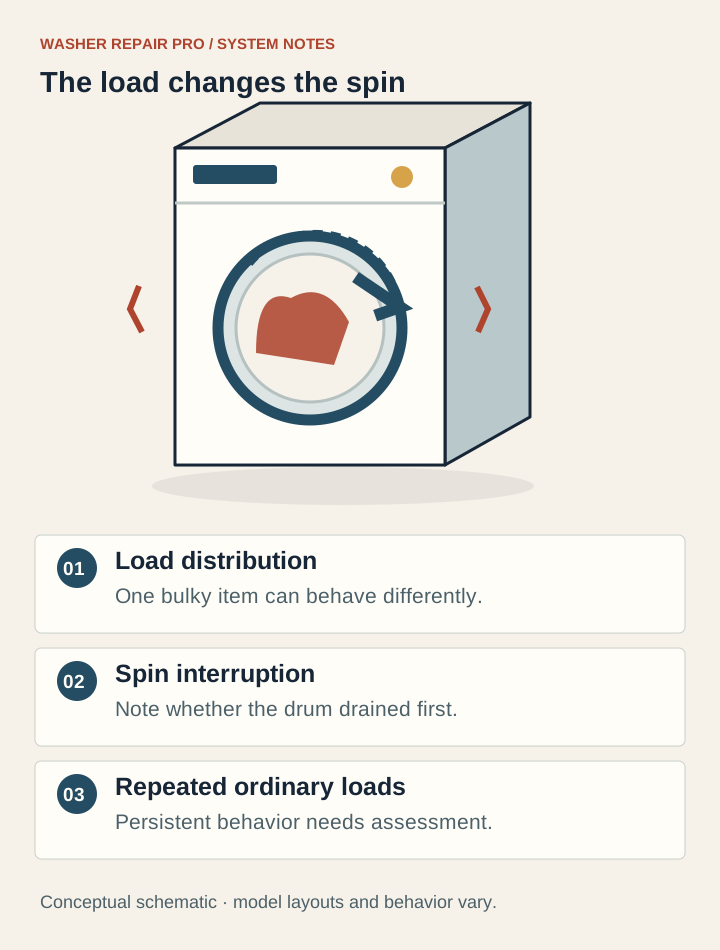
Spin depends on distributing wet laundry around the drum or tub. When that distribution is unsuitable, the washer may slow, stop, or try again rather than reach full speed. A repeated imbalance alert can involve loading or installation, and persistent cases need inspection rather than a diagnosis from the letters alone.
Why the Timer Can Stall While Water Returns
On the top-load platforms covered by LG’s UE article, the machine may add water, agitate to separate items, drain, and try spinning again. The article distinguishes the uE rebalance stage from UE after unsuccessful attempts. Match this behavior against the manual for your model.
Record the sequence instead of only the minutes displayed: “tries to spin, refills, drains, tries again” is useful. If the washer is banging or moving across the floor, stop the cycle using the normal controls. Do not hold the cabinet in place while it runs.
| Pattern | Next useful distinction |
|---|---|
| One blanket or rug triggers UE | Is this item and cycle allowed by the manual? |
| Tiny load cannot finish spin | Is there enough suitable laundry to distribute? |
| Ordinary loads repeatedly fail | Did the washer move or installation change? |
| UE occurs with an empty drum | Request inspection; clothes cannot explain this result. |
Correct the Load Without Creating Another Problem
After the machine stops and unlocks, untangle and redistribute the laundry. Review the manual before adding items: a small load and an overloaded load need different corrections. Separate heavy absorbent items from much lighter fabrics when the model’s loading guidance calls for it.
For a bulky item, check both its care label and the washer’s cycle and capacity guidance. Selecting a bedding cycle does not make an oversized or prohibited item suitable. A lower allowed spin setting may change the outcome, but record that change; it does not establish that a persistent imbalance problem has been repaired.
Installation matters too. Note a recent move, new pedestal, changed floor, or previous leveling work. Any foot adjustment must follow the installation instructions with the washer stopped. Leave stacked equipment and access that requires moving heavy appliances to a qualified installer.
When Redistributing Has Already Failed
Repeatedly rearranging every ordinary load is a reason to document the pattern and arrange assessment. Forum owners describe UE with large, small, and even empty loads. Those reports explain why a useful guide needs an exit from “rebalance again”; they do not prove suspension rods or another part are faulty in your machine.
LG’s top-load guidance includes a no-load rinse-and-spin check and recommends service if the alert returns. Use that only when it matches your model’s instructions and the washer can run safely. Do not run another test through violent vibration or a leak.
Take the provider a compact history: model, load type, when spin stops, whether refilling occurs, installation changes, and any result already observed with no laundry. If suspension or other parts have been replaced, list them and say whether UE changed afterward.
Questions owners ask
Why does my LG washer show UE even when it is empty?
An empty-drum failure deserves inspection rather than more laundry rearranging. On the cited top-load troubleshooting path, LG directs service when UE returns during its no-load check. Give the provider the exact model and already-observed result.
Why does my LG washer keep adding water instead of finishing spin?
Certain top-load models add water as part of their rebalance attempt. Compare the sequence and display with the manual. Repeated unsuccessful attempts or strong vibration call for loading, installation, or repair assessment.
What is the difference between uE and UE?
LG distinguishes a rebalance attempt from an unsuccessful final alert on the top-load platforms in its guide. Capitalization and Ub displays vary by model, so use the full model’s explanation rather than treating every display as identical.
Can a small load cause UE?
Yes. A load can be too small to distribute well, while a large or tangled load can also cause difficulty. Use the model’s loading guidance before adding or removing items.
Should I replace suspension rods for every LG UE error?
No. UE does not identify a failed part, and front-load and top-load suspension designs differ. Begin with the model, loading pattern, and installation history. Persistent problems need inspection before a parts order.
Keep the useful details for service
Record the full model, exact display, cycle stage, water location and checks already attempted. Create a repair brief to copy or download. If several symptoms overlap, use the Washer Repair Check without guessing a component.
Related next steps
Sources & model scope
Content reviewed November 5, 2026. Match the exact model and US owner’s manual. These references support the explanation; they are not evidence of an inspection of your machine.