
LG LE reports a rotation problem: the tub fails to spin or the motor cannot operate normally. An overloaded load or an obstruction can contribute, but the display alone does not confirm a failed motor, Hall sensor, or control board. Use the exact model before following a recovery procedure.
What the message is responding to
The washer needs the drum or tub to move as intended through its cycle. Heavy loading or restricted movement can interrupt that operation. LE identifies the detected rotation problem; finding the reason requires the model, the circumstances, and sometimes a technician’s inspection.
Was It One Heavy Load or a Repeating Pattern?
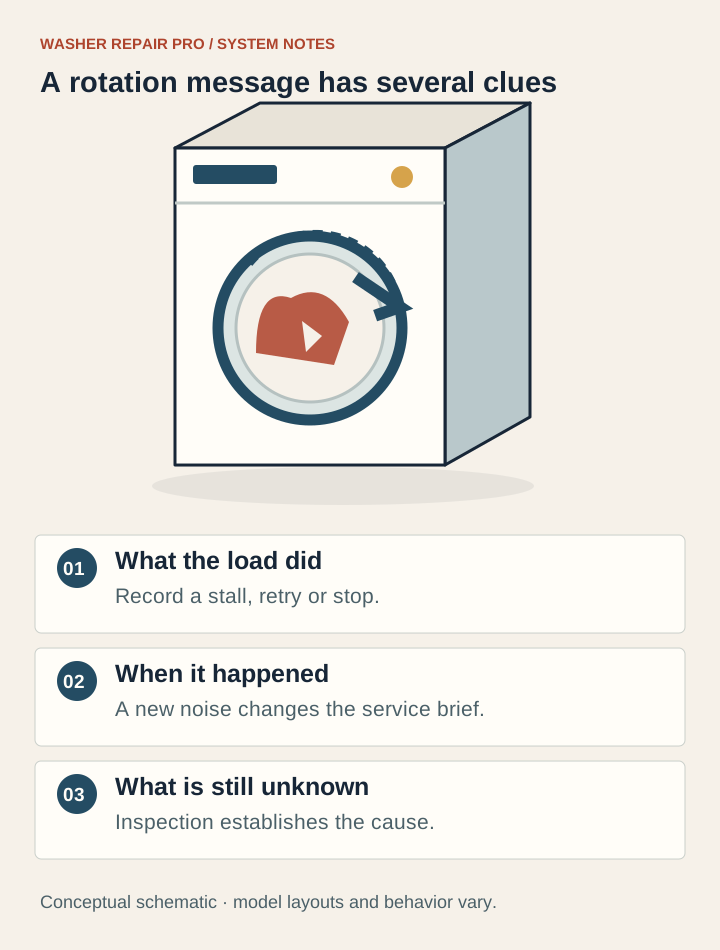
Begin with what was in the washer: a blanket, a tightly packed load, a small ordinary load, or nothing. Then note what happened immediately before LE. Did the drum attempt to move, stop without moving, or make a scraping or grinding noise? Describe what you already observed rather than repeatedly starting it to collect a better video.
A single event with bulky bedding makes load guidance worth checking. LE that returns with an ordinary, appropriately sized load deserves a different service conversation. Report whether reducing the load changed the outcome, and for how long. One successful restart does not settle the cause of an intermittent problem.
| Pattern already observed | What to tell the provider |
|---|---|
| Only with one bulky item | Item, cycle, and load-size guidance used |
| Returns after load reduction | Whether it fails immediately or later |
| Movement begins, then stops | How much movement and any sound |
| Started after a repair or move | Work performed and first cycle afterward |
Keep Recovery Within the Model’s Instructions
Once the washer has stopped and unlocked normally, turn it off and compare the load with the manual’s capacity and bedding-cycle instructions. Do not pull on a locked door or reach into a moving tub. Reducing an overloaded load is an owner action; dismantling the drive system is a different task.
Look only for an obvious loose item in the accessible laundry area. If something is wedged, hidden beneath a wash plate, or requires tools or force, leave it for service. LG’s top-load guidance identifies trapped objects among the possible causes, but top-load and front-load layouts differ.
LG publishes a five-minute unplug-and-retry step in one current general LE article. That is a source-specific recovery step, not a universal reset for every LG platform. Check the matching manual, avoid inaccessible plugs, and stop if the washer is noisy, strained, leaking, or repeatedly failing.
A New Sensor Does Not Close the Diagnosis
Owners ask about LE after a Hall sensor has already been replaced. That is a useful history to share, not a reason to replace another sensor automatically. Record the replacement date, part identification if available, and whether the machine completed any full cycles afterward.
Online discussions can jump from LE to a sensor, wiring, or a board. Those suggestions reflect individual cases. They do not identify the cause in your washer. Do not open internal panels, probe electrical connectors, or use resistance values from another model to decide what to buy.
For a repair request, keep four answers together: the full model, the original load, the first abnormal sound or movement, and the result of any permitted load adjustment or recovery. If there was recent work, say whether LE existed beforehand. This helps the provider distinguish a recurring complaint from a new symptom.
Questions owners ask
Why does LE return after the Hall sensor was replaced?
The replacement history does not establish that the original cause was found. Report whether LE returned immediately or after successful cycles. A technician needs to inspect the model-specific system instead of assuming another sensor is required.
Can an overloaded LG washer show LE?
Yes. LG identifies overloaded laundry as one possible reason the tub cannot spin. Once the machine stops and unlocks, compare the load and cycle with the owner’s manual. Recurrence with suitable loads needs inspection.
How do I reset LE on my LG washer?
Use the procedure documented for the complete model. LG’s general article includes a five-minute power interruption, but a cleared message is not proof of a repair. Do not keep restarting a strained or noisy washer.
Is LE the same problem on an LG top-load washer?
It concerns rotation on the cited top-load guidance too, but related displays and checks differ by platform. Match LE exactly; do not substitute instructions for AE, LE1, or another machine simply because they appear in the same online list.
Should I buy a motor because the washer shows LE?
The code does not prove the motor has failed. Share the load, timing, movement, noises, and previous repairs first. Stop using the washer if it appears jammed or makes unusual mechanical noise.
Keep the useful details for service
Record the full model, exact display, cycle stage, water location and checks already attempted. Create a repair brief to copy or download. If several symptoms overlap, use the Washer Repair Check without guessing a component.
Related next steps
Sources & model scope
Content reviewed November 5, 2026. Match the exact model and US owner’s manual. These references support the explanation; they are not evidence of an inspection of your machine.